
17 Reddit Comment Formulas That Get Upvotes (With Examples)
This guide helps you understand 17 Reddit comment formulas that get upvotes and decide what to do next without wasting posts, links, or account trust. Start by matching your goal to subreddit rules, reader intent, and account risk, then choose the safest next action.
Primary source check: review Reddit Rules, Reddit User Agreement, and Reddit for Business before using this advice in a live campaign.
Some people seem to effortlessly rack up upvotes on every comment. Meanwhile, you write something thoughtful and get...
crickets.
What's the difference?
After analyzing thousands of top comments across Reddit, I found that most high-performing comments follow recognizable patterns. These aren't tricks-they're structures that communicate value effectively.
Here are 17 formulas you can use today to write comments that actually get noticed.
TL;DR - Comment Formulas That Earn Upvotes
- Structure your comments with a clear format: lead with the answer or key point, then explain or support it

- Use the Direct Answer + Explanation formula for questions, the Personal Story formula for advice threads, and the Step-by-Step formula for technical help
- Format for scannability with bullet points, bold text, and short paragraphs since Reddit users scroll fast
- Comment early on rising posts to maximize visibility and combine formulas for stronger responses
- Avoid low-value replies like "This" or vague advice without specifics
Why Comment Structure Matters
Before diving into formulas, understand why structure affects performance:
Scannability: Reddit users scroll fast. Well-structured comments catch the eye.
Value clarity: Structured comments communicate their value immediately. Random thoughts get ignored.
Completeness: Good structure ensures you include everything needed without rambling.
Professionalism: Structured responses signal effort and credibility.
As we covered in our guide on writing comments that get upvotes, structure is half the battle.
The 17 Formulas
Formula 1: The Direct Answer + Explanation
Structure:
- Answer the question (first sentence)
- Explain why (2-3 sentences)
- Optional: Additional context
Example:
"Yes, you should definitely negotiate. Most employers expect it and have built in room for negotiation.
I've never had an offer rescinded for asking professionally. Worst case, they say no and you accept the original offer."
Best for: Advice requests, yes/no questions, factual queries
Formula 2: The Personal Story
Structure:
- Brief context (1-2 sentences)
- Your experience (2-4 sentences)
- What you learned (1-2 sentences)
Example:
"Dealt with this exact issue last year. My dog suddenly stopped eating and acted lethargic for two days.
Turned out he had eaten part of a sock that was causing a partial blockage. Vet found it on X-ray.
If your dog's behavior changed suddenly, I'd push for imaging-blood work alone might not catch it."
Best for: Advice threads, relatable experiences, building credibility
Formula 3: The Step-by-Step
Structure:
- Brief intro (optional)
- Numbered steps
- Conclusion or tip
Example:
"Here's what worked for me:
1. Uninstall the app completely
2.
Restart your phone
3. Download from the official site, not the app store
4.
Install and don't update for 24 hours
The auto-update was causing the crash. This fixed it for me and three others who had the same issue."
Best for: Technical help, how-to questions, process explanations
Formula 4: The Contrarian Take
Structure:
- Acknowledge conventional wisdom
- Present your different view
- Support with evidence/experience
- Invite discussion
Example:
"I know everyone recommends index funds, but I think there's a case for active management if you're young and can handle volatility. I've beaten the S&P 500 for three years now by focusing on small-caps.
Not saying it works for everyone, but 'just buy VTI' isn't the only valid strategy. Anyone else taking a more active approach?"
Best for: Finance, career advice, opinion discussions
Formula 5: The Quick Tip
Structure:
- The tip (one sentence)
- Brief explanation (one sentence, optional)
Example:
"Add site:reddit.com to any Google search. You'll get actual human opinions instead of SEO garbage."Best for: Life pro tips, simple advice, quick wins
Formula 6: The Source Provider
Structure:
- Relevant context
- Link to credible source
- Key takeaway
Example:
"There's actually research on this. This Harvard study found that people who exercise in the morning have better sleep quality than evening exercisers.
The theory is that morning exercise helps regulate circadian rhythm."
Best for: Factual discussions, debates, educational threads
Formula 7: The Empathetic Response
Structure:
- Acknowledge their feelings
- Share understanding/relate
- Offer perspective or support
Example:
"That sounds incredibly frustrating. I'd be upset too if my landlord pulled something like that.
You're not overreacting-this is legitimately bad behavior on their part. Have you checked your lease for any clauses that might protect you?"
Best for: Vent posts, support subreddits, emotional threads
Formula 8: The Pro/Con Analysis
Structure:
- Brief intro
- Pros (bulleted)
- Cons (bulleted)
- Your recommendation
Example:
"I have both, so here's my honest comparison:
MacBook Pro:
- Better build quality
- Superior trackpad
- Longer-lasting resale value
Dell XPS:
- Better value for specs
- Easier to repair/upgrade
- Windows flexibility
For your use case (video editing), I'd go MacBook. The optimization is worth the premium."
Best for: Comparison questions, buying decisions, evaluations
Formula 9: The Insider Perspective
Structure:
- Establish your credibility
- Share insider info
- Explain why it matters
Example:
"Former barista here. The 'secret menu' isn't really secret-it's just customizations that any skilled barista can make.
But here's an actual insider tip: if you want your drink made right, order during slower hours and be specific about your modifications. Rush hour = shortcuts."
Best for: Industry questions, behind-the-scenes curiosity, myth-busting
Formula 10: The Correction (Polite)
Structure:
- Acknowledge what's right
- Gently correct what's wrong
- Provide accurate information
- Cite source if possible
Example:
"Close, but one clarification: while you're right that the heart has four chambers, it's not accurate that all mammals have identical heart structures. Some marine mammals have adaptations for diving that alter their cardiac physiology significantly.
[Source: Nat Geo article on whale hearts]"
Best for: Educational discussions, misinformation threads
Formula 11: The List Answer
Structure:
- Brief intro (optional)
- Bulleted or numbered list
- Closing thought (optional)
Example:
"Books that actually changed how I think:
- *Thinking, Fast and Slow* - finally understood my own biases
- *Atomic Habits* - simple but actually actionable
- *The Mom Test* - not just for startups, useful for anyone asking questions
- *Deep Work* - helped me focus in an age of distraction
All practical, not fluffy self-help."
Best for: Recommendation requests, top-X questions, resource gathering
Formula 12: The Humble Expert
Structure:
- Establish expertise casually
- Answer thoroughly
- Acknowledge limitations
- Offer to elaborate
Example:
"I've been a physical therapist for 12 years, and knee pain like you're describing could be several things. Most commonly: IT band syndrome, patellar tendinitis, or a meniscus issue.
Without an exam I can't diagnose, but I'd start with rest, ice, and see if specific movements make it worse. Happy to give more specific stretches if you describe the exact location and when it hurts."
Best for: Medical, legal, technical questions (with appropriate disclaimers)
Formula 13: The Analogous Explanation
Structure:
- Identify confusion point
- Provide analogy
- Connect back to original topic
Example:
"Think of it like a highway during rush hour. The 'bandwidth' is how many lanes the highway has.
'Latency' is how long it takes for any single car to get from point A to point B. You can have a 10-lane highway (high bandwidth) but if there's construction, each car still takes forever (high latency).
That's why gamers care about ping even when they have fast internet."
Best for: ELI5 threads, technical explanations, teaching
Formula 14: The Devil's Advocate
Structure:
- Acknowledge main argument
- Present counter-perspective
- Note you're not necessarily arguing this
- Invite discussion
Example:
"Devil's advocate here: while remote work has obvious benefits, companies aren't crazy for wanting some in-person time. Collaboration is genuinely different in person, and some people really do slack off at home.
I'm fully remote and love it, but I can see why a company might want hybrid. What aspects of in-person work do people actually miss?"
Best for: One-sided discussions, echo chambers, debate threads
Formula 15: The Detailed How-To
Structure:
- Acknowledge the goal
- Prerequisites (if any)
- Step-by-step instructions
- Common mistakes to avoid
- Expected result
Example:
"Here's exactly how to fix that:
You'll need: Phillips screwdriver, thermal paste, compressed air
Steps:
1. Power off and unplug everything
2.
Remove the four screws on the back panel
3. Carefully lift off the cover (there's a clip on the left side)
4.
Clean existing paste with isopropyl alcohol
5. Apply pea-sized amount of new paste
6.
Reassemble in reverse order
Watch out for: Don't touch the CPU directly with fingers-oils cause issues. >
Your temps should drop 10-20°C."
Best for: Technical help, DIY requests, troubleshooting
Formula 16: The Reality Check
Structure:
- Acknowledge their hope/plan
- Present realistic perspective
- Suggest adjustment
- Remain supportive
Example:
"I don't want to crush your dreams, but a few things to consider: most YouTube channels never get monetized, and even those that do usually make less than minimum wage for the hours put in. That said, if you genuinely enjoy making content, do it for fun and see where it goes.
Just don't quit your job yet, and maybe give it 6-12 months of consistent posting before evaluating whether it could be a career."
Best for: Career questions, business ideas, reality vs. expectations
Formula 17: The Encouraging Response
Structure:
- Validate their achievement/effort
- Add specific praise
- Offer encouragement for next steps
Example:
"This is genuinely impressive for a first attempt. The composition is solid, and your color choices work well together.
Keep at it-most professional artists would tell you their first piece was way worse than this. If you want feedback: the lighting on the left side could be softened.
But seriously, you've got a good eye. Looking forward to seeing your progress."
Best for: Creative shares, progress posts, beginner questions
Matching Formulas to Situations
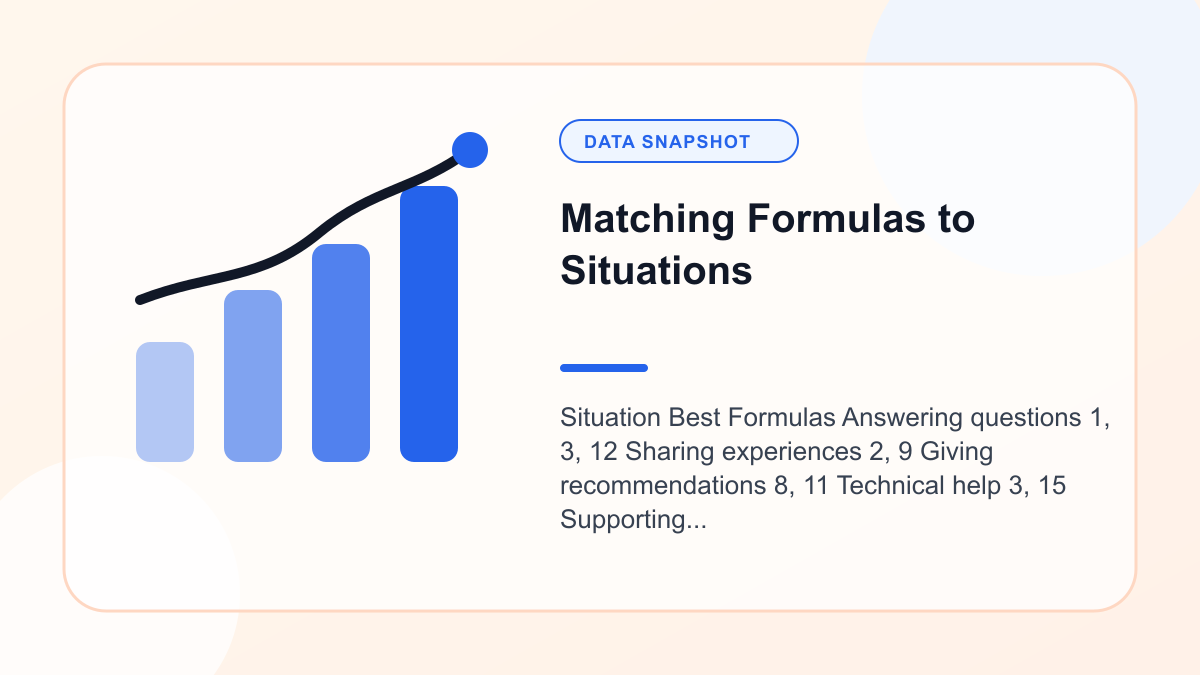
Situation | Best Formulas |
|---|---|
Answering questions | #1, #3, #12 |
Sharing experiences | #2, #9 |
Giving recommendations | #8, #11 |
Technical help | #3, #15 |
Supporting someone | #7, #17 |
Starting discussion | #4, #14 |
Teaching/explaining | #6, #13 |
Quick value | #5, #11 |
Combining Formulas
The best comments often combine elements:
- Story + Tip: Share your experience, then give actionable advice
- Correction + Source: Gently correct misinformation with evidence
- Empathy + Reality Check: Validate feelings before offering perspective
- Insider + How-To: Use your expertise to give detailed instructions
Common Mistakes to Avoid
Just Agreeing
"This. So much this." adds zero value.
If you agree, explain why or add something new.
Unsolicited Criticism
Unless someone asked for feedback, tread carefully with criticism. Even then, be constructive.
Rambling Without Structure
Stream-of-consciousness comments lose readers. Pick a structure and stick to it.
Being Vague
"It depends" without explaining on what isn't helpful. Specificity adds value.
Late Pile-Ons
Don't add the 50th comment saying the same thing as the top 49.
Building Karma with Comments
These formulas are perfect for building Reddit karma:
- Browse "Rising" for posts with potential
- Pick a formula that fits the discussion
- Write a substantive, helpful response
- Post early to maximize visibility
Conclusion
Good comments aren't random-they follow patterns that communicate value clearly. These 17 formulas cover most situations you'll encounter on Reddit.
The key principles:
- Lead with value (don't bury the useful part)
- Be specific (vague advice isn't helpful)
- Structure for scanning (people scroll fast)
- Match the tone (formal vs. casual varies by subreddit)
Practice these formulas until they become instinct. Soon you'll write high-performing comments without even thinking about structure.
For more on Reddit success, explore our guides on posting titles that get clicks and choosing the right subreddits.
Frequently Asked Questions
How do I write Reddit comments that get upvoted?▼
Structure your comments clearly using proven formulas: lead with direct answers, share relevant personal experience, use numbered steps for instructions, and format for scannability. Post early on rising threads for maximum visibility.
What is the best format for a Reddit comment?▼
The best format depends on context. For questions, lead with a direct answer then explain. For advice, share personal experience then actionable tips. For comparisons, use pros/cons lists. Always use paragraphs and formatting for readability.
How long should Reddit comments be?▼
Length should match the complexity of your point. Quick tips can be one sentence. Detailed advice might be several paragraphs. The key is value density—every sentence should earn its place. Long comments work if well-structured.
How do I give advice on Reddit without being preachy?▼
Share personal experience rather than lecturing. Use phrases like 'What worked for me...' instead of 'You should...' Acknowledge limitations in your knowledge. Invite discussion rather than presenting your view as the only answer.
Should I use bullet points in Reddit comments?▼
Yes, especially for lists, steps, or comparisons. Bullet points make comments scannable and easier to read. They signal organization and effort. Use them for any comment with multiple distinct points.
How do I respectfully disagree in a Reddit comment?▼
Acknowledge what's correct first. Present your different view as a perspective, not absolute truth. Support with evidence or experience. Use phrases like 'I see it differently because...' rather than 'You're wrong.' Invite further discussion.

Neo Anderson
Author
Reddit strategist and founder of Upvote.sh. I help brands cut through the noise on Reddit with data-driven upvote strategies that actually move the needle. When I'm not reverse-engineering the front page algorithm, I'm probably lurking in niche subreddits looking for the next big opportunity.